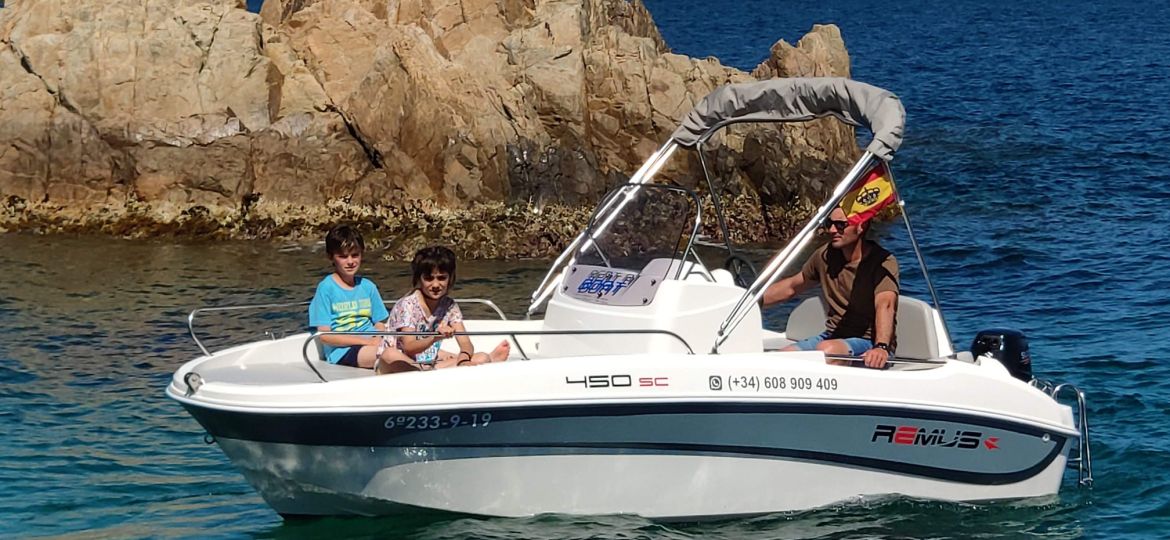

When we sail off Palamós and sail along the coast, we usually look at the color of the water or the shape of the coves. But few people really wonder how the coves of the Costa Brava how the coves of the Costa Brava were formed or why the cliffs or why the cliffs have such characteristic irregular shapes.
The answer lies in geology. And understanding it completely changes the way you look at the landscape when you sail.
The granite origin of the Costa Brava
Much of the Costa Brava’s coastline is formed by granitic rock. This type of rock originated millions of years ago, when magma slowly cooled beneath the earth’s surface.
Over time, erosion exposed these granite masses, which today form cliffs, rounded blocks and rock walls that appear to be sculpted.
This origin explains why many coves in Palamós have:
- Rounded rocks
- Smooth but abrupt shapes
- Light and pink shades
- Natural vertical fractures
Marine erosion: landscape sculptor
The sea is the great artist of this coast.
For thousands of years, the waves have been wearing away the weakest areas of the rock. Natural fractures in the granite allowed water to penetrate and widen cracks.
Thus were born many of the small coves that we visit today by boat.
The combination of:
- Constant swell
- Temperature changes
- Wind
- Salinity
has shaped the landscape to create the irregular profile that defines the geology of the Costa Brava.
Why are there so many small creeks?
Unlike other areas of the Mediterranean with long straight beaches, here small sea inlets predominate.
This occurs because:
- Granitic rock fractures irregularly.
- The sea selectively erodes the weakest areas.
- The most resistant areas remain as overhangs or capes.
The result is a succession of coves, cliffs and small bays that make this coast unique.
Differences between the north and south of Palamós
If you sail from Palamós to the north, you will observe a more abrupt coastline, with marked reliefs and very visible rock formations.
To the south, the coast combines rocky areas with more open beaches and progressive bottoms.
This variation responds to structural differences in the terrain and how erosion has acted in each section.
If you want to go through these contrasts, you can consult the boat routes from Palamós to appreciate these differences from the sea.
The role of sea level
Thousands of years ago, the sea level was not the same as it is today. During the ice ages, the sea receded and exposed areas that are now submerged.
When the level rose again, it flooded ancient valleys and fractures, forming coves and inlets.
Many of the current coves of the Costa Brava are actually ancient geographical features invaded by the sea.
Vegetation and relief
Geology not only determines the shape of the coast, it also conditions the vegetation.
The steep slopes and rocky soil are favorable:
- Mediterranean pines
- Low scrub
- Salt-resistant vegetation
This contrast between light rock, intense green and deep blue is one of the most recognizable images of the coast.
The perspective from the sea
Seeing the Costa Brava from land is an experience. But observing the formation of its cliffs from the sea allows you to appreciate details impossible to see from trails or viewpoints.
From a boat you can:
- Observe vertical fractures
- See sea caves
- Identify color changes in the rock
- Understanding how the waves hit certain areas
If you are thinking of experiencing this perspective, you can consult the service of boat rental in Palamós to explore the coast at your leisure.
Seabed and water transparency
The granitic origin also influences the seabed.
In many areas:
- The bottom is rocky
- Sand is scarce
- The water is especially clear
This favors the characteristic transparency of the Costa Brava and allows the observation of shallow underwater formations.
Navigate with knowledge of the environment
Understanding geology is not just curiosity. It also improves navigation.
Knowing that an area is rocky or that a cove has an uneven bottom helps:
- Choosing the best place to anchor
- Identify safe zones
- Respect sensitive areas
To anchor correctly in these areas, you can consult this guide to anchoring in Palamós.
Landscape and perception
The irregularity of the coastline means that each stretch offers a different perspective depending on the light of day.
The shadows on the granite change tonality and the rocks acquire golden hues at sunset.
Understanding the formation of the Costa Brava makes the experience richer and more conscious.
The next time you sail off Palamós and see a small cove hidden between cliffs, remember that this landscape is the result of millions of years of geological processes.
Understanding how the coves of the Costa Brava were formed transforms the sailing experience. It is no longer just a boat ride: it is a journey through the natural history of the territory.
The Costa Brava is not just a destination. It is a living landscape, sculpted by time and the sea.